
Recreation during the Elizabethan Era encompassed spectator/blood sports, team sports, simple games, and individual amusement activities. Queen Elizabeth enjoyed hunting--at age 67 she was occasionally found on horseback loving the "thrill of the chase".
 Two sports now considered
inhumane were active twice a week in London. These "blood sports" thought by most
people today to be too gruesome, cruel and violent, had great appeal for the Elizatethans.
Large crowds of both men and women of all classes flocked to see bear baiting
or bull baiting , and Elizabeth frequently used it to entertain visiting ambassadors.
"The average Elizabethan," writes historian M.St. Clair Byrne, "was not sensitive
to the spectacle of physical suffering, either in human beings or in animals."
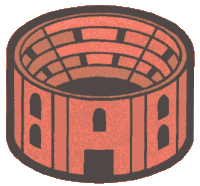
The building shown here on the left was the arena where bear and bull baiting
was held.
Two sports now considered
inhumane were active twice a week in London. These "blood sports" thought by most
people today to be too gruesome, cruel and violent, had great appeal for the Elizatethans.
Large crowds of both men and women of all classes flocked to see bear baiting
or bull baiting , and Elizabeth frequently used it to entertain visiting ambassadors.
"The average Elizabethan," writes historian M.St. Clair Byrne, "was not sensitive
to the spectacle of physical suffering, either in human beings or in animals."
The building shown here on the left was the arena where bear and bull baiting
was held.
 Bearbaiting
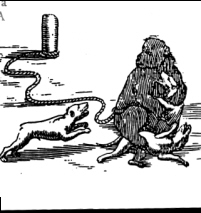
involved a bear tied to a stake by a long rope. The animal was put into a pit
where four or five large, fierce dogs call mastiff (or in some cases, lions)
were let in for the sole purpose of attacking the confined bear. Any dogs that
might survive the bear's retaliation were pulled off just before the bear was
killed. The dogs would be considered winners if the large animal was killed,
but losers if many of them were disabled that the rest refused to attack. Sometimes
apes were used instead of bears.
Bearbaiting
involved a bear tied to a stake by a long rope. The animal was put into a pit
where four or five large, fierce dogs call mastiff (or in some cases, lions)
were let in for the sole purpose of attacking the confined bear. Any dogs that
might survive the bear's retaliation were pulled off just before the bear was
killed. The dogs would be considered winners if the large animal was killed,
but losers if many of them were disabled that the rest refused to attack. Sometimes
apes were used instead of bears.
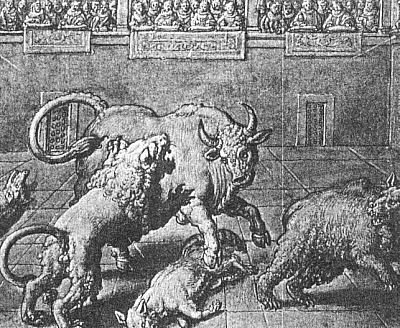
 Bullbaiting was much the same as Bearbaiting, except that the bull was let into
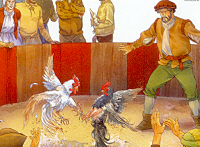
the pit and "worried to death" - teased or hurt until it died. Cockfighting
was another popular blood sport. Roosters were fitted with sharp blades on each
foot and put into a pit to fight to the death. Fighting cocks were expensive,
so it took a well-to-do man to own these birds, but men of all classes came
to see and bet on the fights.
Bullbaiting was much the same as Bearbaiting, except that the bull was let into
the pit and "worried to death" - teased or hurt until it died. Cockfighting
was another popular blood sport. Roosters were fitted with sharp blades on each
foot and put into a pit to fight to the death. Fighting cocks were expensive,
so it took a well-to-do man to own these birds, but men of all classes came
to see and bet on the fights.
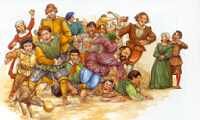 Team sports
gained in popularity during Elizabeth's reign. They, too, were rough and violent
like the sports involving animals. Common men played football (not an ancestor
of American football, despite the similarities) received its name not because
the ball was kicked but because all the players went on foot. It was extremely
violent as there were few rules. Hurling, a combination of hockey and polo,
had some players on foot, others on horseback. The object of the game was to
strike a ball (with a stick or a club) so that it went over the opponents' goal.
Country hurling might match the entire adult male populations of two villages,
and the goals might be three or four miles apart. Soccer was also played, but
the government frowned upon it since it was the cause of many riots and bloodshed.
Team sports
gained in popularity during Elizabeth's reign. They, too, were rough and violent
like the sports involving animals. Common men played football (not an ancestor
of American football, despite the similarities) received its name not because
the ball was kicked but because all the players went on foot. It was extremely
violent as there were few rules. Hurling, a combination of hockey and polo,
had some players on foot, others on horseback. The object of the game was to
strike a ball (with a stick or a club) so that it went over the opponents' goal.
Country hurling might match the entire adult male populations of two villages,
and the goals might be three or four miles apart. Soccer was also played, but
the government frowned upon it since it was the cause of many riots and bloodshed.
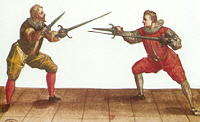
 Fencing
was one of the most popular of sports. Betting was commonplace as one of the contestants
might bet that he could hit his opponent a certain number of times. In addition,
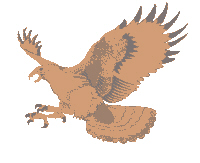
much time was spent with the sport of hawking - very popular with gentlemen. Training
a hawk or a falcon began with the capturing of a wild bird, then taming it by
sealing its eyes with needle and thread, then tying the thread back over the head
of the bird so that the trainer could open and close the bird's eyes at will.
The temporary blinding made it very easy to train the hawk or falcon to hunt other
birds. Bells were attached to the birds legs so that the trainer could keep track
of its whereabouts.
Fencing
was one of the most popular of sports. Betting was commonplace as one of the contestants
might bet that he could hit his opponent a certain number of times. In addition,
much time was spent with the sport of hawking - very popular with gentlemen. Training
a hawk or a falcon began with the capturing of a wild bird, then taming it by
sealing its eyes with needle and thread, then tying the thread back over the head
of the bird so that the trainer could open and close the bird's eyes at will.
The temporary blinding made it very easy to train the hawk or falcon to hunt other
birds. Bells were attached to the birds legs so that the trainer could keep track
of its whereabouts.
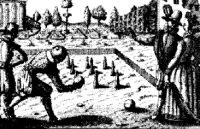 The game of BOWLS
refers to a popular Elizabethan game in which a small "bowl," or ball (called
a jack) was used as a mark at the end of a green lawn. The players roll their
bowls toward the jack, and the one coming closest to it would be the winner. When
a bowl touched a jack, it was said to "kiss" it. The bowl was not perfectly round
- rather lopsided to make the ball curve in a haphazard way.
The game of BOWLS
refers to a popular Elizabethan game in which a small "bowl," or ball (called
a jack) was used as a mark at the end of a green lawn. The players roll their
bowls toward the jack, and the one coming closest to it would be the winner. When
a bowl touched a jack, it was said to "kiss" it. The bowl was not perfectly round
- rather lopsided to make the ball curve in a haphazard way.
And if you are bored with these popular amusements, perhaps you might find more interesting things to do. Many Elizabethans occupied their time with various activities.
Of course, the Elizabethan Era being the time of Shakespeare, going to the theatre was always an option. Attending the most well-known, The Globe Theatre was an adventure in itself. Many of Shakespeare's plays (he acted in some of them) were performed at this magnificient theatre.
World Events |
Fashions |
Everyday Living |
The Plague |
Recreation & Sports |
Crime and Punishment |
Education |
Customs & Beliefs |